
|
CGAL 6.1 - Homological Discrete Vector Fields
|
Loading...
Searching...
No Matches
|
CGAL 6.1 - Homological Discrete Vector Fields
|
#include <CGAL/HDVF/Hdvf_duality.h>
CGAL::HDVF::Hdvf_core< CoefficientType, ComplexType, OSM::Sparse_chain, OSM::Sub_sparse_matrix >.
The class Hdvf_duality is the implementation of homological discrete vector fields (HDVF for short) for Alexander duality computation.
In dimension \(n\), given a complex \(L\) homeomorphic to \(\mathcal S^n\) and a sub-complex \(K\subseteq L\), Alexander duality states that for all \(q\leqslant n\):
\[\tilde H_q(K) \simeq \tilde H^{n-q-1}(L-K)\]
where \(\tilde H_q\) and \(\tilde H^q\) denote reduced homology and cohomology groups.
In [Gonzalez and al. 2025], the authors prove that, even if \(L-K\) is not a sub-complex, it produces a valid chain complex (we call "co-complex" such a complementary of sub-complex). Hence, its homology/cohomology can be computed and for all \(q\leqslant n\):
\[\tilde H_q(K) \simeq \tilde H^{q+1}(L-K)\]
HDVFs provide a fast and convenient mean to compute this isomorphism. In order to work with convenient finite complexes, the complex \(L\) must be homeomorphic to a ball of dimension \(n\) (thus \(\mathcal S^n\) is actually homeomorphic to \(L\) plus an infinite \(n\)-cell closing its boundary).
Perfect HDVFs are first computed over \(K\) and \(L-K\) (providing corresponding relative homology) respectively and Alexander isomorphism gives rise to a pairing between critical cells in \(K\) and \(L-K\), that is a pairing between homology/cohomology generators in \(K\) and \(L-K\).
The class provides HDVF constuction operations: compute_perfect_hdvf() and compute_rand_perfect_hdvf(), which build perfect HDVFs over \(K\) and \(L-K\) respectively. Then, compute_alexander_pairing() computes Alexander isomorphism (and provides a pairing between homology/cohomology generators in \(K\) and \(L-K\)).
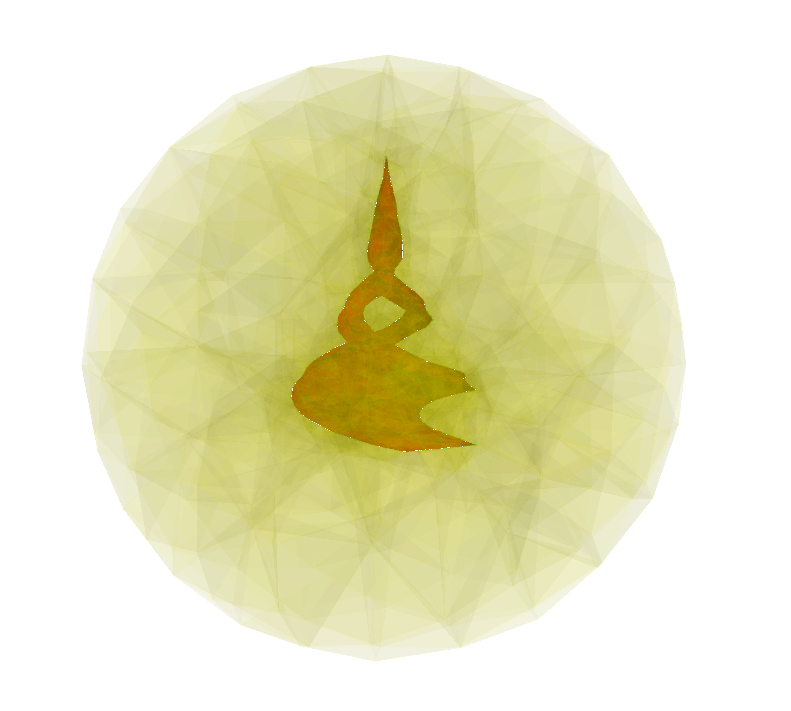
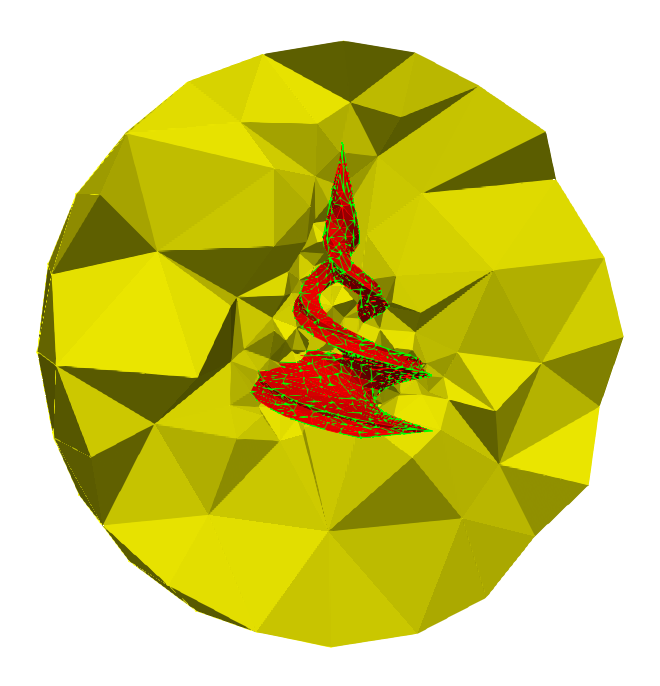
Example of Alexander duality isomorphism. The twirl mesh is a subcomplex K of a larger complex L depicted in yellow, homeomorphic to the ball of dimension 3 (right - sectional view).
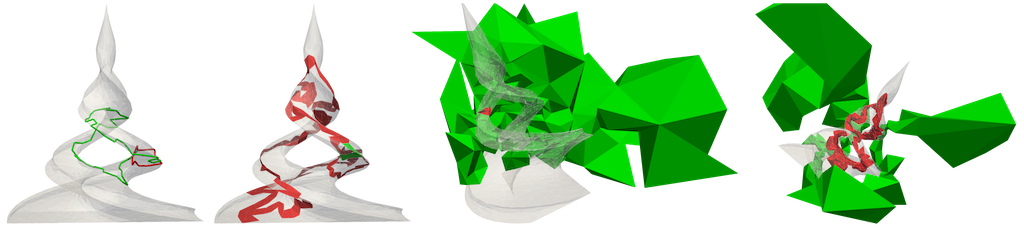
Figure 92.1 Example of "homological quartet for the twirl model". 1: Homology generators of the twirl \(H_1(K)\), 2: Cohomology generators of the twirl \(H^1(K)\), 3: Homology generators of the complementary of the twirl \(H_1(L-K)\), 4: Cohomology generators of the complementary of the twirl \(H^1(L-K)\). Alexander isomorphism is represented through colours (paired generators have similar colours).
Hence, each hole in \(K\) gives rise to four generators (called its "homological quarted": its homology and cohomology generators in \(K_q\) and the homology and cohomology generators paired with them in \((L-K)_{q+1}\)).
In order to compute relative homology, a sub chain complex mask is used to partially screen the complex L and thus restrict HDVF computation. This mask is called "current mask" (and can be set over K or L-K).
HDVF | CoefficientType | a model of the Ring concept providing the ring used to compute homology. |
| ComplexType | a model of the AbstractChainComplex concept, providing the type of abstract chain complex used. |
[Gonzalez and al. 2025] Gonzalez-Lorenzo, A., Bac, A. & Gazull, YS. A constructive approach of Alexander duality. J Appl. and Comput. Topology 9, 2 (2025).
Public Member Functions | |
| Hdvf_duality (const ComplexType &L, Sub_chain_complex_mask< CoefficientType, ComplexType > &K, int hdvf_opt=OPT_FULL) | |
Hdvf_duality constructor ( from a complex L and a sub-complex K) | |
| virtual PairCell | find_pair_A (int q, bool &found) const |
| Finds a valid PairCell of dimension q / q+1 for A in the current sub chain complex. | |
| virtual PairCell | find_pair_A (int q, bool &found, size_t gamma) const |
Finds a valid PairCell for A containing gamma in the current sub chain complex (a cell of dimension q) | |
| virtual std::vector< PairCell > | find_pairs_A (int q, bool &found) const |
| Finds all valid PairCell of dimension q / q+1 in the current sub chain complex for A. | |
| virtual std::vector< PairCell > | find_pairs_A (int q, bool &found, size_t gamma) const |
Finds all valid PairCell for A containing gamma in the current sub chain complex (a cell of dimension q) | |
| void | set_mask_K () |
Sets the current sub chain complex masks over K. | |
| void | set_mask_L_K () |
Sets the current sub chain complex masks over L-K. | |
| Sub_chain_complex_mask< CoefficientType, ComplexType > | get_current_mask () |
| Returns the value of the current sub chain complex mask. | |
| std::vector< PairCell > | compute_perfect_hdvf (bool verbose=false) |
| Computes a perfect HDVF over the current sub chain complex. | |
| std::vector< PairCell > | compute_rand_perfect_hdvf (bool verbose=false) |
| Computes a random perfect HDVF over the current sub chain complex. | |
| std::vector< PairCell > | compute_pairing_hdvf () |
| Computes a "pairing" HDVF between K and L-K. | |
| std::vector< PairCell > | compute_rand_pairing_hdvf () |
| Computes a random "pairing" HDVF between K and L-K. | |
| vector< vector< size_t > > | get_flag (FlagType flag) const |
Gets cells with a given flag in any dimension in the current sub chain complex. | |
| vector< size_t > | get_flag_dim (FlagType flag, int q) const |
Gets cells with a given flag in dimension q in the current sub chain complex. | |
| virtual ostream & | print_reduction (ostream &out=cout) |
Prints the homology and cohomology reduction information for K and L-K. | |
| virtual ostream & | print_reduction_sub (ostream &out=cout) |
| Prints the homology and cohomology reduction information for the current such chain complex. | |
| ostream & | print_bnd_pairing (ostream &out=cout) |
Prints the reduced boundary over critical cells of K and L-K. | |
| virtual vector< vector< int > > | get_psc_labels () const |
| Exports primary/secondary/critical labels of the current sub chain complex for vtk export. | |
| virtual CChain | get_homology_chain (size_t cell, int dim) const |
Exports homology generators of the current sub chain complex associated to cell (critical cell) of dimension q (used by vtk export). | |
| virtual CChain | get_cohomology_chain (size_t cell, int dim) const |
Exports cohomology generators of the current sub chain complex associated to cell (critical cell) of dimension q (used by vtk export). | |
 Public Member Functions inherited from CGAL::HDVF::Hdvf_core< CoefficientType, ComplexType, OSM::Sparse_chain, OSM::Sub_sparse_matrix > Public Member Functions inherited from CGAL::HDVF::Hdvf_core< CoefficientType, ComplexType, OSM::Sparse_chain, OSM::Sub_sparse_matrix > | |
| Hdvf_core (const ComplexType &K, int hdvf_opt=OPT_FULL) | |
| Default constructor. | |
| Hdvf_core (const Hdvf_core &hdvf) | |
| ~Hdvf_core () | |
| virtual PairCell | find_pair_A (int q, bool &found) const |
| Finds a valid PairCell of dimension q / q+1 for A. | |
| virtual PairCell | find_pair_A (int q, bool &found, size_t gamma) const |
Finds a valid PairCell for A containing gamma (a cell of dimension q) | |
| virtual std::vector< PairCell > | find_pairs_A (int q, bool &found) const |
| Finds all valid PairCell of dimension q / q+1 for A. | |
| virtual std::vector< PairCell > | find_pairs_A (int q, bool &found, size_t gamma) const |
Finds all valid PairCell for A containing gamma (a cell of dimension q) | |
| void | A (size_t gamma1, size_t gamma2, int q) |
| A operation: pairs critical cells. | |
| std::vector< PairCell > | compute_perfect_hdvf (bool verbose=false) |
| Computes a perfect HDVF. | |
| std::vector< PairCell > | compute_rand_perfect_hdvf (bool verbose=false) |
| Computes a random perfect HDVF. | |
| bool | is_perfect_hdvf () |
| Tests if a HDVF is perfect. | |
| virtual std::vector< std::vector< size_t > > | get_flag (FlagType flag) const |
Gets cells with a given flag in any dimension. | |
| virtual std::vector< size_t > | get_flag_dim (FlagType flag, int q) const |
Gets cells with a given flag in dimension q. | |
| FlagType | get_cell_flag (int q, size_t tau) const |
Gets the flag of the cell tau in dimension q. | |
| int | get_hdvf_opts () const |
| Gets HDVF computation option. | |
| const RMatrix & | get_f (int q) const |
| Gets the row-major matrix of \(f\) (from the reduction associated to the HDVF). | |
| const CMatrix & | get_g (int q) const |
| Gets the column-major matrix of \(g\) (from the reduction associated to the HDVF). | |
| const CMatrix & | get_h (int q) const |
| Gets the column-major matrix of \(h\) (from the reduction associated to the HDVF). | |
| const CMatrix & | get_dd (int q) const |
| Gets the column-major matrix of \(\partial'\), reduced boundary operator (from the reduction associated to the HDVF). | |
| std::ostream & | print_matrices (std::ostream &out=std::cout) const |
| Prints the matrices of the reduction. | |
| std::ostream & | print_reduction (std::ostream &out=std::cout) const |
| Prints the homology and cohomology reduction information. | |
| virtual std::vector< std::vector< int > > | get_psc_labels () const |
| Exports primary/secondary/critical labels (in particular for vtk export) | |
| virtual CChain | get_homology_chain (size_t cell, int q) const |
Gets homology generators associated to cell (critical cell) of dimension q (used by vtk export). | |
| virtual CChain | get_cohomology_chain (size_t cell, int dim) const |
Gets cohomology generators associated to cell (critical cell) of dimension q (used by vtk export). | |
| std::ostream & | save_hdvf_reduction (std::ostream &out) |
| Saves a HDVF together with the associated reduction (f, g, h, d matrices) | |
| std::istream & | load_hdvf_reduction (std::istream &out) |
| Loads a HDVF together with the associated reduction (f, g, h, d matrices) | |
Additional Inherited Members | |
| Public Types inherited from CGAL::HDVF::Hdvf_core< CoefficientType, ComplexType, OSM::Sparse_chain, OSM::Sub_sparse_matrix > | |
| typedef OSM::Sparse_chain< CoefficientType, OSM::COLUMN > | CChain |
| Type of column-major chains. | |
| typedef OSM::Sparse_chain< CoefficientType, OSM::ROW > | RChain |
| Type of row-major chains. | |
| typedef OSM::Sub_sparse_matrix< CoefficientType, OSM::COLUMN > | CMatrix |
| Type of column-major sparse matrices. | |
| typedef OSM::Sub_sparse_matrix< CoefficientType, OSM::ROW > | RMatrix |
| Type of row-major sparse matrices. | |
| Protected Member Functions inherited from CGAL::HDVF::Hdvf_core< CoefficientType, ComplexType, OSM::Sparse_chain, OSM::Sub_sparse_matrix > | |
| OSM::Sparse_chain< CoefficientType, ChainTypeFlag > | projection (const OSM::Sparse_chain< CoefficientType, ChainTypeFlag > &chain, FlagType flag, int q) const |
| void | progress_bar (size_t i, size_t n) |
| Protected Attributes inherited from CGAL::HDVF::Hdvf_core< CoefficientType, ComplexType, OSM::Sparse_chain, OSM::Sub_sparse_matrix > | |
| std::vector< std::vector< FlagType > > | _flag |
| std::vector< size_t > | _nb_P |
| std::vector< size_t > | _nb_S |
| std::vector< size_t > | _nb_C |
| std::vector< RMatrix > | _F_row |
| std::vector< CMatrix > | _G_col |
| std::vector< CMatrix > | _H_col |
| std::vector< CMatrix > | _DD_col |
| const ComplexType & | _K |
| int | _hdvf_opt |
| CGAL::HDVF::Hdvf_duality< CoefficientType, ComplexType >::Hdvf_duality | ( | const ComplexType & | L, |
| Sub_chain_complex_mask< CoefficientType, ComplexType > & | K, | ||
| int | hdvf_opt = OPT_FULL |
||
| ) |
Hdvf_duality constructor ( from a complex L and a sub-complex K)
L is a complex of a given dimension \(n\) homeomorphic to \(\mathcal B^n\) and K is a sub-complex of L described by a bitboard (cells of K have a bit set to 1, cells of K have a bit set to 0).
Initially, the sub chain complex mask is set to K.
| [in] | L | A complex of a given dimension \(n\) homeomorphic to \(\mathcal B^n\). |
| [in] | K | A sub complex of L encoded through a bitboard. |
| [in] | hdvf_opt | Option for HDVF computation (OPT_BND, OPT_F, OPT_G or OPT_FULL). |
| std::vector< PairCell > CGAL::HDVF::Hdvf_duality< CoefficientType, ComplexType >::compute_pairing_hdvf |
Computes a "pairing" HDVF between K and L-K.
compute_perfect_hdvf() first (to build perfect HDVFs over K and L-K respectively).The function computes a perfect HDVF over remaining critical cells. Each pair of cells inserted with the A() operation maps corresponding homology/cohomology generators in the Alexander isomorphism.
| std::vector< PairCell > CGAL::HDVF::Hdvf_duality< CoefficientType, ComplexType >::compute_perfect_hdvf | ( | bool | verbose = false | ) |
Computes a perfect HDVF over the current sub chain complex.
As long as valid pairs for A exist in the current sub chain complex, the function selects the first available pair (returned by find_pair_A()) and applies the corresponding A() operation. If the Ring of coefficients is a field, this operation always produces a perfect HDVF (ie. the reduced boundary is null and the reduction provides homology and cohomology information). Otherwise the operation produces a maximal HDVF with a residual boundary matrix over critical cells.
If the HDVF is initially not trivial (some cells have already been paired), the function completes it into a perfect HDVF.
| [in] | verbose | If this parameter is true, all intermediate reductions are printed out. |
PairCell paired with A. | std::vector< PairCell > CGAL::HDVF::Hdvf_duality< CoefficientType, ComplexType >::compute_rand_pairing_hdvf |
Computes a random "pairing" HDVF between K and L-K.
compute_perfect_hdvf() first (to build perfect HDVFs over K and L-K respectively).The function computes a random perfect HDVF over remaining critical cells. Each pair of cells inserted with the `A() operation maps corresponding homology/cohomology generators in the Alexander isomorphism.
| std::vector< PairCell > CGAL::HDVF::Hdvf_duality< CoefficientType, ComplexType >::compute_rand_perfect_hdvf | ( | bool | verbose = false | ) |
Computes a random perfect HDVF over the current sub chain complex.
As long as valid pairs for A exist in the current sub chain complex, the function selects a random pair (among pairs returned by find_pairs_A()) and applies the corresponding A() operation. If the Ring of coefficients is a field, this operation always produces a perfect HDVF (that is the reduced boundary is null and the reduction provides homology and cohomology information).
If the HDVF is initially not trivial (some cells have already been paired), the function randomly completes it into a perfect HDVF.
compute_perfect_hdvf() (finding out all possible valid pairs requires additional time).| [in] | verbose | If this parameter is true, all intermediate reductions are printed out. |
|
virtual |
Finds a valid PairCell of dimension q / q+1 for A in the current sub chain complex.
The function searches a pair of critical cells, in the current sub chain complex, \((\gamma_1, \gamma2)\) of dimension q / q+1, valid for A (ie. such that \(\langle \partial_{q+1}(\gamma_2), \gamma_1 \rangle\) invertible). It returns the first valid pair found by iterators.
| [in] | q | Lower dimension of the pair. |
| [in] | found | Reference to a Boolean variable. The method sets found to true if a valid pair is found, false otherwise. |
Reimplemented from CGAL::HDVF::Hdvf_core< CoefficientType, ComplexType, OSM::Sparse_chain, OSM::Sub_sparse_matrix >.
|
virtual |
Finds a valid PairCell for A containing gamma in the current sub chain complex (a cell of dimension q)
The function searches a cell \(\gamma'\) in the current sub chain complex such that one of the following conditions holds:
| [in] | q | Dimension of the cell gamma. |
| [in] | found | Reference to a Boolean variable. The method sets found to true if a valid pair is found, false otherwise. |
| [in] | gamma | Index of a cell to pair. |
Reimplemented from CGAL::HDVF::Hdvf_core< CoefficientType, ComplexType, OSM::Sparse_chain, OSM::Sub_sparse_matrix >.
|
virtual |
Finds all valid PairCell of dimension q / q+1 in the current sub chain complex for A.
The function searches all pairs of critical cells \((\gamma_1, \gamma2)\) in the current sub chain complex of dimension q / q+1, valid for A (ie. such that \(\langle \partial_{q+1}(\gamma_2), \gamma_1 \rangle\) invertible). It returns a vector of such pairs.
| [in] | q | Lower dimension of the pair. |
| [in] | found | Reference to a Boolean variable. The method sets found to true if a valid pair is found, false otherwise. |
Reimplemented from CGAL::HDVF::Hdvf_core< CoefficientType, ComplexType, OSM::Sparse_chain, OSM::Sub_sparse_matrix >.
|
virtual |
Finds all valid PairCell for A containing gamma in the current sub chain complex (a cell of dimension q)
The function searches all CRITICAL cells \(\gamma'\) in the current sub chain complex such that one of the following conditions holds:
| [in] | q | Dimension of the cell gamma. |
| [in] | found | Reference to a Boolean variable. The method sets found to true if a valid pair is found, false otherwise. |
| [in] | gamma | Index of a cell to pair. |
Reimplemented from CGAL::HDVF::Hdvf_core< CoefficientType, ComplexType, OSM::Sparse_chain, OSM::Sub_sparse_matrix >.
|
virtual |
Exports cohomology generators of the current sub chain complex associated to cell (critical cell) of dimension q (used by vtk export).
The method exports the chain \(f^\star(\sigma)\) for \(\sigma\) the cell of index cell and dimension q.
Reimplemented from CGAL::HDVF::Hdvf_core< CoefficientType, ComplexType, OSM::Sparse_chain, OSM::Sub_sparse_matrix >.
|
virtual |
Gets cells with a given flag in any dimension in the current sub chain complex.
The function returns a vector containing, for each dimension, the vector of cells with a given flag.
| [in] | flag | Flag to select. |
Reimplemented from CGAL::HDVF::Hdvf_core< CoefficientType, ComplexType, OSM::Sparse_chain, OSM::Sub_sparse_matrix >.
|
virtual |
Gets cells with a given flag in dimension q in the current sub chain complex.
The function returns the vector of cells of dimension q with a given flag.
| [in] | flag | Flag to select. |
| [in] | q | Dimension visited. |
Reimplemented from CGAL::HDVF::Hdvf_core< CoefficientType, ComplexType, OSM::Sparse_chain, OSM::Sub_sparse_matrix >.
|
virtual |
Exports homology generators of the current sub chain complex associated to cell (critical cell) of dimension q (used by vtk export).
The method exports the chain \(g(\sigma)\) for \(\sigma\) the cell of index cell and dimension q.
Reimplemented from CGAL::HDVF::Hdvf_core< CoefficientType, ComplexType, OSM::Sparse_chain, OSM::Sub_sparse_matrix >.
|
virtual |
Exports primary/secondary/critical labels of the current sub chain complex for vtk export.
The method exports the labels of every cells in each dimension.
Reimplemented from CGAL::HDVF::Hdvf_core< CoefficientType, ComplexType, OSM::Sparse_chain, OSM::Sub_sparse_matrix >.
| ostream & CGAL::HDVF::Hdvf_duality< CoefficientType, ComplexType >::print_bnd_pairing | ( | ostream & | out = cout | ) |
Prints the reduced boundary over critical cells of K and L-K.
The method prints out the reduced boundary matrix in each dimension, restricted to critical cells of K and L-K (ie. the matrix used to compute Alexander pairing).
compute_perfect_hdvf().By default, outputs the complex to std::cout.
|
virtual |
Prints the homology and cohomology reduction information for K and L-K.
Prints \(f^*\), \(g\) \(\partial'\) the reduced boundary over each critical cell.
By default, outputs the complex to std::cout.
|
virtual |
Prints the homology and cohomology reduction information for the current such chain complex.
Prints \(f^*\), \(g\) \(\partial'\) the reduced boundary over each critical cell.
By default, outputs the complex to std::cout.
| void CGAL::HDVF::Hdvf_duality< CoefficientType, ComplexType >::set_mask_K | ( | ) |
Sets the current sub chain complex masks over K.
Further HDVF computations will be restricted to K (ie. computation of reduced homology).
| void CGAL::HDVF::Hdvf_duality< CoefficientType, ComplexType >::set_mask_L_K | ( | ) |
Sets the current sub chain complex masks over L-K.
Further HDVF computations will be restricted to L-K (ie. computation of reduced homology).
 1.9.6
1.9.6