
- The size of the pixel. The plane will be tiled with square pixels of that width such that the origin is the center of a pixel.
-
Type:
GT::FT - Default: FT(1.)
|
CGAL 6.2 - 2D Snap Rounding
|
Loading...
Searching...
No Matches
|
CGAL 6.2 - 2D Snap Rounding
|
Optional parameters of the functions of this package are implemented as Named Parameters. The page Named Parameters describes their usage.
CGAL::Hot_pixel_snap_rounding_traits_2CGAL::Double_grid_snap_rounding_traits_2CGAL::Float_grid_snap_rounding_traits_2CGAL::Integer_grid_snap_rounding_traits_2 Modules | |
| Concepts | |
Classes | |
| struct | CGAL::Double_grid_snap_rounding_traits_2< InputKernel, ExactKernel, BaseTraits > |
The class Double_grid_snap_rounding_traits_2<InputKernel, ExactKernel, BaseTraits> is a model of the VerticalSlabSnapRoundingTraits_2 concept. More... | |
| struct | CGAL::Float_grid_snap_rounding_traits_2< InputKernel, ExactKernel, BaseTraits > |
The class Float_grid_snap_rounding_traits_2<InputKernel, ExactKernel, BaseTraits> is a model of the VerticalSlabSnapRoundingTraits_2 concept. More... | |
| class | CGAL::Hot_pixel_snap_rounding_traits_2< Base_kernel > |
The class Hot_pixel_snap_rounding_traits_2<Kernel> is a model of the HotPixelSnapRoundingTraits_2 concept. More... | |
| struct | CGAL::Integer_grid_snap_rounding_traits_2< InputKernel, ExactKernel, BaseTraits > |
The class Integer_grid_snap_rounding_traits_2<InputKernel, ExactKernel, BaseTraits> is a model of the VerticalSlabSnapRoundingTraits_2 concept. More... | |
Functions | |
| template<class SegmentRange , class OutputPolylineIterator , class NamedParameters = parameters::Default_named_parameters> | |
| OutputPolylineIterator | CGAL::hot_pixel_snap_rounding_2 (const SegmentRange &segments, OutputPolylineIterator out, const NamedParameters &np=parameters::default_values()) |
| subdivides and rounds a range of segments so that they are pairwise disjoint in their interiors. | |
| template<class SegmentRange , class OutputSegmentIterator , class NamedParameters = parameters::Default_named_parameters> | |
| OutputSegmentIterator | CGAL::hot_pixel_snap_rounding_2 (const SegmentRange &segments, OutputSegmentIterator out, const NamedParameters &np=parameters::default_values()) |
| subdivides and rounds a range of segments so that they are pairwise disjoint in their interiors. | |
| template<class PolygonRange , class OutputPolygonIterator , class NamedParameters = parameters::Default_named_parameters> | |
| OutputPolygonIterator | CGAL::hot_pixel_snap_rounding_2 (PolygonRange &polygons, OutputPolygonIterator out, const NamedParameters &np=parameters::default_values()) |
| subdivides and rounds a range of polygons so that their boundary segments are pairwise disjoint in their interiors. | |
| template<class SegmentRange , class OutputPolylineIterator , class NamedParameters = parameters::Default_named_parameters> | |
| OutputPolylineIterator | CGAL::snap_rounding_2 (const SegmentRange &segments, OutputPolylineIterator out, const NamedParameters &np=parameters::default_values()) |
| subdivides and rounds a range of segments so that they are pairwise disjoint in their interiors. | |
| template<class SegmentRange , class OutputSegmentIterator , class NamedParameters = parameters::Default_named_parameters> | |
| OutputSegmentIterator | CGAL::snap_rounding_2 (const SegmentRange &segments, OutputSegmentIterator out, const NamedParameters &np=parameters::default_values()) |
| subdivides and rounds a range of segments so that they are pairwise disjoint in their interiors. | |
| template<class PolygonRange , class OutputPolygonIterator , class NamedParameters = parameters::Default_named_parameters> | |
| OutputPolygonIterator | CGAL::snap_rounding_2 (PolygonRange &polygons, OutputPolygonIterator out, const NamedParameters &np=parameters::default_values()) |
| subdivides and rounds a range of polygons so that their boundary segments are pairwise disjoint in their interiors. | |
| template<class Traits , class InputIterator , class OutputContainer > | |
| void | CGAL::snap_rounding_2 (InputIterator begin, InputIterator end, OutputContainer &output_container, typename Traits::NT pixel_size, bool do_isr=true, bool int_output=true, unsigned int number_of_kd_trees=1) |
| template<class SegmentRange , class OutputPolylineIterator , class NamedParameters = parameters::Default_named_parameters> | |
| OutputPolylineIterator | CGAL::vertical_slab_snap_rounding_2 (const SegmentRange &segments, OutputPolylineIterator out, const NamedParameters &np=parameters::default_values()) |
| subdivides and rounds a range of segments so that they are pairwise disjoint in their interiors. | |
| template<class SegmentRange , class OutputSegmentIterator , class NamedParameters = parameters::Default_named_parameters> | |
| OutputSegmentIterator | CGAL::vertical_slab_snap_rounding_2 (const SegmentRange &segments, OutputSegmentIterator out, const NamedParameters &np=parameters::default_values()) |
| subdivides and rounds a range of segments so that they are pairwise disjoint in their interiors. | |
| template<class PolygonRange , class OutputPolygonIterator , class NamedParameters = parameters::Default_named_parameters> | |
| OutputPolygonIterator | CGAL::vertical_slab_snap_rounding_2 (PolygonRange &polygons, OutputPolygonIterator out, const NamedParameters &np=parameters::default_values()) |
| subdivides and rounds a range of polygons so that their boundary segments are pairwise disjoint in their interiors. | |
| OutputPolylineIterator CGAL::hot_pixel_snap_rounding_2 | ( | const SegmentRange & | segments, |
| OutputPolylineIterator | out, | ||
| const NamedParameters & | np = parameters::default_values() |
||
| ) |
#include <CGAL/hot_pixel_snap_rounding_2.h>
subdivides and rounds a range of segments so that they are pairwise disjoint in their interiors.
The output is a range of polylines, where each polyline corresponds to an input segment.
| SegmentRange | a range of whose value type is model of Kernel::Segment_2 |
| OutputPolylineIterator | model of OutputIterator holding Polyline. Polyline must be a type that provides a push_back(Point_2) function. |
| NamedParameters | a sequence of Named Parameters |
| segments | the input segment range |
| out | the output inserter |
| np | an optional sequence of Named Parameters among the ones listed below |
| |
| |
| |
|
| OutputSegmentIterator CGAL::hot_pixel_snap_rounding_2 | ( | const SegmentRange & | segments, |
| OutputSegmentIterator | out, | ||
| const NamedParameters & | np = parameters::default_values() |
||
| ) |
#include <CGAL/hot_pixel_snap_rounding_2.h>
subdivides and rounds a range of segments so that they are pairwise disjoint in their interiors.
The output is a range of segments.
| SegmentRange | a range whose value type is model of Kernel::Segment_2 |
| OutputSegmentIterator | model of OutputIterator holding Kernel::Segment_2 |
| NamedParameters | a sequence of Named Parameters |
| segments | the input segment range |
| out | the output inserter |
| np | an optional sequence of Named Parameters among the ones listed below |
| |
| |
| |
|
| OutputPolygonIterator CGAL::hot_pixel_snap_rounding_2 | ( | PolygonRange & | polygons, |
| OutputPolygonIterator | out, | ||
| const NamedParameters & | np = parameters::default_values() |
||
| ) |
#include <CGAL/hot_pixel_snap_rounding_2.h>
subdivides and rounds a range of polygons so that their boundary segments are pairwise disjoint in their interiors.
If the input polygons are disjoint, the output polygons remain non-overlapping, although they may share vertices or edges. Each output polygon is free of self-intersections but may present pinched sections.
| PolygonRange | a range of CGAL::Polygon_2 |
| OutputPolygonIterator | model of OutputIterator holding CGAL::Polygon_2 |
| NamedParameters | a sequence of Named Parameters |
| polygons | the range of input polygons |
| out | the output inserter |
| np | an optional sequence of Named Parameters among the ones listed below |
| |
| |
| |
|
| OutputPolylineIterator CGAL::snap_rounding_2 | ( | const SegmentRange & | segments, |
| OutputPolylineIterator | out, | ||
| const NamedParameters & | np = parameters::default_values() |
||
| ) |
#include <CGAL/snap_rounding_2.h>
subdivides and rounds a range of segments so that they are pairwise disjoint in their interiors.
The output is a range of polylines, where each polyline corresponds to an input segment.
calls the function CGAL::vertical_slab_snap_rounding_2() or CGAL::hot_pixel_snap_rounding_2() depending if geom_traits is model of VerticalSlabSnapRoundingTraits_2 or HotPixelSnapRoundingTraits_2.
| SegmentRange | a range of whose value type is model of Kernel::Segment_2 |
| OutputPolylineIterator | model of OutputIterator holding Polyline. Polyline must be a type that provides a push_back(Point_2) function. |
| NamedParameters | a sequence of Named Parameters |
| segments | the input segment range |
| out | the output inserter |
| np | an optional sequence of Named Parameters including the one listed below |
|
| OutputSegmentIterator CGAL::snap_rounding_2 | ( | const SegmentRange & | segments, |
| OutputSegmentIterator | out, | ||
| const NamedParameters & | np = parameters::default_values() |
||
| ) |
#include <CGAL/snap_rounding_2.h>
subdivides and rounds a range of segments so that they are pairwise disjoint in their interiors.
The output is a range of segments.
calls the function CGAL::vertical_slab_snap_rounding_2() or CGAL::hot_pixel_snap_rounding_2() depending if the parameter geom_traits is model of VerticalSlabSnapRoundingTraits_2 or HotPixelSnapRoundingTraits_2.
| SegmentRange | a range whose value type is model of Kernel::Segment_2 |
| OutputSegmentIterator | model of OutputIterator holding Kernel::Segment_2 |
| NamedParameters | a sequence of Named Parameters |
| segments | the input segment range |
| out | the output inserter |
| np | an optional sequence of Named Parameters including the one listed below |
|
| void CGAL::snap_rounding_2 | ( | InputIterator | begin, |
| InputIterator | end, | ||
| OutputContainer & | output_container, | ||
| typename Traits::NT | pixel_size, | ||
| bool | do_isr = true, |
||
| bool | int_output = true, |
||
| unsigned int | number_of_kd_trees = 1 |
||
| ) |
#include <CGAL/Snap_rounding_2.h>
CGAL::snap_rounding_2() or CGAL::hot_pixel_snap_rounding_2()| Traits | must be a model of HotPixelSnapRoundingTraits_2. |
| InputIterator | must be an iterator with value type Traits::Segment_2. |
| OutputContainer | must be a container with a method push_back(const OutputContainer::value_type& c), where OutputContainer::value_type must be a container with a method push_back(const Traits::Point_2& p) |
| begin,end | The first two parameters denote the iterator range of the input segments. |
| output_container | is a reference to a container of the output polylines. Since a polyline is composed of a sequence of points, a polyline is a container itself. |
| do_isr | The fifth parameter determines whether to apply ISR or SR. |
| pixel_size | The fourth parameter denotes the pixel size w. The plane will be tiled with square pixels of width w such that the origin is the center of a pixel. pixel_size must have a positive value. |
| int_output | The sixth parameter denotes the output representation. If the value of the sixth parameter is true then the centers of pixels constitute the integer grid, and hence the vertices of the output polylines will be integers. For example, the coordinates of the center of the pixel to the right of the pixel containing the origin will be (1,0) regardless of the pixel width. If the value of the sixth parameter is false, then the centers of hot pixels (and hence the vertices of the output polylines) will bear their original coordinates, which may not necessarily be integers. In the latter case, the coordinates of the center of the pixel to the right of the pixel containing the origin, for example, will be (w,0). |
| number_of_kd_trees | The seventh parameter is briefly described later on this page; for a detailed description see [3]. |
Snap Rounding (SR, for short) is a well-known method for converting arbitrary-precision arrangements of segments into a fixed-precision representation [1], [2], [4]. In the study of robust geometric computing, it can be classified as a finite precision approximation technique. Iterated Snap Rounding (ISR, for short) is a modification of SR in which each vertex is at least half-the-width-of-a-pixel away from any non-incident edge [3]. This package supports both methods. Algorithmic details and experimental results are given in [3].
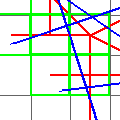
Given a finite collection \( \Sc\) of segments in the plane, the arrangement of \( \Sc\) denoted \( \Ac(\Sc)\) is the subdivision of the plane into vertices, edges, and faces induced by \( \Sc\). A vertex of the arrangement is either a segment endpoint or the intersection of two segments. Given an arrangement of segments whose vertices are represented with arbitrary-precision coordinates, SR proceeds as follows. We tile the plane with a grid of unit squares, pixels, each centered at a point with integer coordinates. A pixel is hot if it contains a vertex of the arrangement. Each vertex of the arrangement is replaced by the center of the hot pixel containing it and each edge \( e\) is replaced by the polygonal chain through the centers of the hot pixels met by \( e\), in the same order as they are met by \( e\).
In a snap-rounded arrangement, the distance between a vertex and a non-incident edge can be extremely small compared with the width of a pixel in the grid used for rounding. ISR is a modification of SR which makes a vertex and a non-incident edge well separated (the distance between each is at least half-the-width-of-a-pixel). However, the guaranteed quality of the approximation in ISR degrades. For more details on ISR see [3].
The traits used here must support (arbitrary-precision) rational number type as this is a basic requirement of SR.
About the Number of kd-Trees
A basic query used in the algorithm is to report the hot pixels of size \( w\) that a certain segment \( s\) intersects. An alternative way to do the same is to query the hot pixels' centers contained in a Minkowski sum of \( s\) with a pixel of width \( w\) centered at the origin; we denote this Minkowski sum by \( M(s)\). Since efficiently implementing this kind of query is difficult, we use an orthogonal range-search structure instead. We query with the bounding box \( B(M(s))\) of \( M(s)\) in a two-dimensional kd-tree which stores the centers of hot pixels. Since \( B(M(s))\) in general is larger than \( M(s)\), we still need to filter out the hot pixels which do not intersect \( s\).
While this approach is easy to implement with CGAL, it may incur considerable overhead since the area of \( B(M(s))\) may be much larger than the area of \( M(s)\), possibly resulting in many redundant hot pixels to filter out. Our heuristic solution, which we describe next, is to use a cluster of kd-trees rather than just one. The cluster includes several kd-trees, each has the plane, and hence the centers of hot pixels, rotated by a different angle in the first quadrant of the plane; for our purpose, a rotation by angles outside this quadrant is symmetric to a rotation by an angle in the first quadrant.
Given a parameter \( c\), the angles of rotation are \( (i - 1)
\frac{\pi}{2c}, i=1,\ldots,c\), and we construct a kd-tree corresponding to each of these angles. Then for a query segment \( s\), we choose the kd-tree for which the area of \( B(M(s))\) is the smallest, in order to (potentially) get less hot pixels to filter out. Since constructing many kd-trees may be costly, our algorithm avoids building a kd-tree which it expects to be queried a relatively small number of times (we estimate this number in advance). How many kd-trees should be used? It is difficult to provide a simple answer for that. There are inputs for which the time to build more than one kd-tree is far greater than the time saved by having to filter out less hot pixels (sparse arrangements demonstrate this behavior), and there are inputs which benefit from using several kd-trees. Thus, the user can control the number of kd-trees with the parameter number_of_kd_trees. Typically, but not always, one kd-tree (the default) is sufficient.
| OutputPolygonIterator CGAL::snap_rounding_2 | ( | PolygonRange & | polygons, |
| OutputPolygonIterator | out, | ||
| const NamedParameters & | np = parameters::default_values() |
||
| ) |
#include <CGAL/snap_rounding_2.h>
subdivides and rounds a range of polygons so that their boundary segments are pairwise disjoint in their interiors.
If the input polygons are disjoint, the output polygons remain non-overlapping, although they may share vertices or edges. Each output polygon is free of self-intersections but may present pinched sections.
calls the function CGAL::vertical_slab_snap_rounding_2() or CGAL::hot_pixel_snap_rounding_2() depending if geom_traits is model of VerticalSlabSnapRoundingTraits_2 or HotPixelSnapRoundingTraits_2.
| PolygonRange | a range of CGAL::Polygon_2 |
| OutputPolygonIterator | model of OutputIterator holding CGAL::Polygon_2 |
| NamedParameters | a sequence of Named Parameters |
| polygons | the range of input polygons |
| out | the output inserter |
| np | an optional sequence of Named Parameters including the one listed below |
|
| OutputPolylineIterator CGAL::vertical_slab_snap_rounding_2 | ( | const SegmentRange & | segments, |
| OutputPolylineIterator | out, | ||
| const NamedParameters & | np = parameters::default_values() |
||
| ) |
#include <CGAL/vertical_slab_snap_rounding_2.h>
subdivides and rounds a range of segments so that they are pairwise disjoint in their interiors.
The output is a range of polylines, where each polyline corresponds to an input segment.
| SegmentRange | a range of whose value type is model of Kernel::Segment_2 |
| OutputPolylineIterator | model of OutputIterator holding Polyline. Polyline must be a type that provides a push_back(Point_2) function. |
| NamedParameters | a sequence of Named Parameters |
| segments | the input segment range |
| out | the output inserter |
| np | an optional sequence of Named Parameters among the ones listed below |
|
| OutputSegmentIterator CGAL::vertical_slab_snap_rounding_2 | ( | const SegmentRange & | segments, |
| OutputSegmentIterator | out, | ||
| const NamedParameters & | np = parameters::default_values() |
||
| ) |
#include <CGAL/vertical_slab_snap_rounding_2.h>
subdivides and rounds a range of segments so that they are pairwise disjoint in their interiors.
The output is a range of segments.
| SegmentRange | a range whose value type is model of Kernel::Segment_2 |
| OutputSegmentIterator | model of OutputIterator holding Kernel::Segment_2 |
| NamedParameters | a sequence of Named Parameters |
| segments | the input segment range |
| out | the output inserter |
| np | an optional sequence of Named Parameters among the ones listed below |
|
| OutputPolygonIterator CGAL::vertical_slab_snap_rounding_2 | ( | PolygonRange & | polygons, |
| OutputPolygonIterator | out, | ||
| const NamedParameters & | np = parameters::default_values() |
||
| ) |
#include <CGAL/vertical_slab_snap_rounding_2.h>
subdivides and rounds a range of polygons so that their boundary segments are pairwise disjoint in their interiors.
If the input polygons are disjoint, the output polygons remain non-overlapping, although they may share vertices or edges. Each output polygon is free of self-intersections but may present pinched sections.
| PolygonRange | a range of CGAL::Polygon_2 |
| OutputPolygonIterator | model of OutputIterator holding CGAL::Polygon_2 |
| NamedParameters | a sequence of Named Parameters |
| polygons | the range of input polygons |
| out | the output inserter |
| np | an optional sequence of Named Parameters among the ones listed below |
|
 1.9.6
1.9.6