Efi Fogel
This package can be used to construct, maintain, and alter arrangements on a curve. Once an arrangement is constructed, the package can be used to obtain results of various queries on the arrangement, such as point location. The package also supports operations on arrangements, such as computing the overlay of two arrangements. Arrangements and arrangement components can also be extended to store additional data.
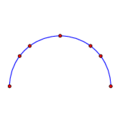
Given a set \(\mathcal{P}\) of points on a curve, the arrangement \({\mathcal A}({\mathcal P})\) is the subdivision of the curve induced by the points in \(\mathcal{P}\) into maximally connected cells. The cells can be \(0\)-dimensional (vertices) or \(1\)-dimensional (edges).
The class CGAL::Arrangement_on_curve_1::Arrangement_on_curve_1<GeometryTraits_1, TopologyTraits, BinarySearch> encapsulates a data structure that maintains arrangements of points. It comes with a variety of algorithms that operate on 1D arrangements, such as point-location queries and overlay computations, which are implemented as peripheral classes or as free (global) functions.
Classified Reference Pages
Enumerations
- CGAL::Arrangement_on_curve_1::Interval_parameter_space
- CGAL::Arrangement_on_curve_1::Parameter_space
Tags
- CGAL::Arrangement_on_curve_1::Open_side_tag
- CGAL::Arrangement_on_curve_1::Closed_side_tag
- CGAL::Arrangement_on_curve_1::Identified_side_tag
Concepts
- ArrangementOnCurve_1
- AocTraits_1
- AocClosedBoundaryTraits_1
- AocIdentifiedBoundaryTraits_1
- AocTopologyTraits
Geometric Object Concepts
Function Object Concepts
Classes
- CGAL::Arrangement_on_curve_1::Arrangement_on_curve_1<GeometryTraits_1, TopologyTraits, BinarySearch>
- CGAL::Arrangement_on_curve_1::Right_closed_topology_traits<GeometryTraits_1, VertexData, EdgeData, UseVector, Allocator>
- CGAL::Arrangement_on_curve_1::Left_closed_topology_traits<GeometryTraits_1, VertexData, EdgeData, UseVector, Allocator>
- CGAL::Arrangement_on_curve_1::Open_topology_traits<GeometryTraits_1, VertexData, EdgeData, UseVector, Allocator>
- CGAL::Arrangement_on_curve_1::Closed_topology_traits<GeometryTraits_1, VertexData, EdgeData, UseVector, Allocator>
- CGAL::Arrangement_on_curve_1::Identified_topology_traits<GeometryTraits_1, VertexData, EdgeData, UseVector, Allocator>
- CGAL::Arrangement_on_curve_1::Default_topology_traits<GeometryTraits_1, VertexData, EdgeData, UseVector, Allocator>
- CGAL::Arrangement_on_curve_1::Line_traits_1<Kernel>
- CGAL::Arrangement_on_curve_1::Segment_traits_1<Kernel>
- CGAL::Arrangement_on_curve_1::Left_ray_traits_1<Kernel>
- CGAL::Arrangement_on_curve_1::Right_ray_traits_1<Kernel>
- CGAL::Arrangement_on_curve_1::Line_2_traits_1<Kernel>
- CGAL::Arrangement_on_curve_1::Line_3_traits_1<Kernel>
- CGAL::Arrangement_on_curve_1::Line_d_traits_1<Kernel>
- CGAL::Arrangement_on_curve_1::Circle_traits_1<Kernel>
- CGAL::Arrangement_on_curve_1::Open_geom_traits_2_adaptor_1<GeomTraits_2>
- CGAL::Arrangement_on_curve_1::Closed_geom_traits_2_adaptor_1<GeomTraits_2>
- CGAL::Arrangement_on_curve_1::Left_closed_geom_traits_2_adaptor_1<GeomTraits_2>
- CGAL::Arrangement_on_curve_1::Right_closed_geom_traits_2_adaptor_1<GeomTraits_2>
- CGAL::Arrangement_on_curve_1::Identified_geom_traits_2_adaptor_1<GeomTraits_2>
- CGAL::Arrangement_on_curve_1::Copy_overlay_visitor<ArrangementA, ArrangementB, ArrangementR>
- CGAL::Arrangement_on_curve_1::Default_overlay_visitor<ArrangementA, ArrangementB, ArrangementR>
Functions
Topics | |
| Concepts | |
| I/O | |
| Free Functions | |
| Geometry Traits Classes | |
| Topology Traits Classes | |
| Tags | |
| Enumerations | |
Classes | |
| class | CGAL::Arrangement_on_curve_1::Arrangement_on_curve_1< GeometryTraits_1, TopologyTraits, BinarySearch > |
| Arrangement_on_curve_1 represents a subdivision of a continuous 1D curve, referred to as the master curve, into maximally connected subcurves. More... | |
| class | CGAL::Arrangement_on_curve_1::Copy_overlay_visitor< ArrangementA, ArrangementB, ArrangementR > |
| The class template Copy_overlay_visitor is an overlay visitor that copies the user data of the input cells to the cells of the resulting arrangement. More... | |
| class | CGAL::Arrangement_on_curve_1::Default_overlay_visitor< ArrangementA, ArrangementB, ArrangementR > |
| The class template Default_overlay_visitor is an overlay visitor whose callback functions do nothing; the cells of the resulting arrangement are left with default-constructed data, if any. More... | |